





1. Brookhaven Makes Roleplay Easy Because the City Explains Itself
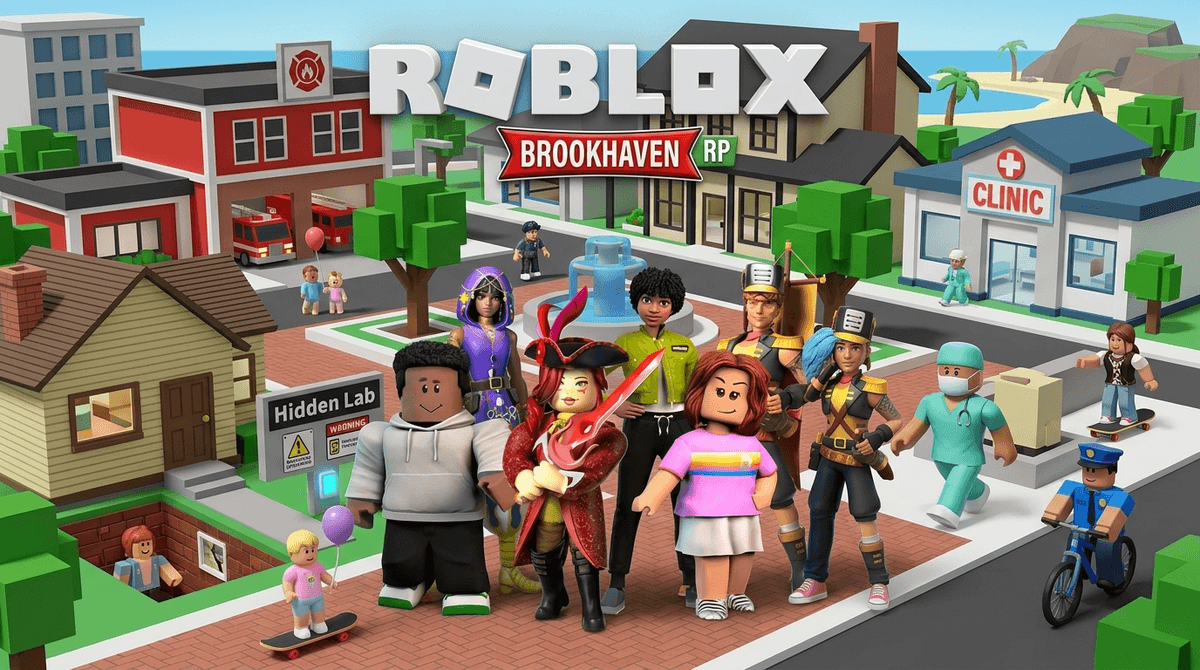
Many roleplay games expect players to understand detailed rules, character histories, jobs, economies, or server customs before they can participate comfortably. Brookhaven RP takes the opposite approach, presenting a compact city filled with locations whose meanings are immediately recognizable, so even someone entering for the first time can understand that the hospital suggests an emergency, the school creates student and teacher roles, while the police station naturally supports crime, investigation, arrest, or rescue scenarios.
This familiarity reduces one of the largest barriers in social games: the awkward moment when a player wants to participate but does not know what everyone else is doing. In Brookhaven, the location often provides enough context to make an educated guess. A police vehicle parked outside a house suggests a problem, an ambulance near the road implies an accident, while several players gathering at school can create a recognizable scene before anyone writes a detailed explanation.
The game does not need a complex quest system to distribute roles because architecture performs part of that work. Players understand how these places function in real life, television, movies, and other games, which allows Brookhaven to borrow an enormous amount of cultural knowledge without teaching it directly.
That simplicity is easy to dismiss as shallow design. In practice, it is the foundation that allows strangers with different ages, experience levels, and expectations to begin improvising together almost immediately.
2. Buildings Function Like Prompts Rather Than Permanent Content
A hospital in a traditional game might contain missions, healing systems, staff progression, or carefully scripted events. Brookhaven’s hospital is valuable for a different reason because it provides enough recognizable objects and spaces for players to decide what is happening there themselves.
The same room can support several completely different situations. It may become the setting for an accident, a mysterious illness, a family emergency, a medical examination, or an exaggerated disaster involving half the server. The building does not enforce one interpretation, which means its usefulness comes from how many stories players can project onto it.
This principle applies across the city. Houses can become family homes, secret headquarters, crime scenes, hotels, laboratories, schools, prisons, or locations for parties that collapse into chaos after five minutes. A shop can support ordinary employment roleplay in one server and become the center of a robbery in another.
Brookhaven therefore gains replayability without needing every location to contain a large amount of mechanical content. The places remain useful because they behave like prompts, giving players a recognizable starting point while leaving enough empty space for improvisation.
The weakness is that players who expect detailed activities may find many interiors mechanically limited. Objects often exist to support imagination rather than complex simulation, so the city can feel empty when nobody is actively creating a scenario.
Brookhaven’s locations are not designed to entertain players independently. They are designed to give players something understandable to do with one another.

3. Vehicles Communicate Roles Before Anyone Types a Message
Vehicles in Brookhaven RP provide transportation, but their more important function is often visual communication. A police car, ambulance, family vehicle, luxury car, motorcycle, helicopter, or ordinary truck tells other players something about the person arriving before that player says anything. This makes vehicles part of the roleplay vocabulary.
Someone driving an ambulance can enter an accident scene and be recognized as medical staff immediately. A police vehicle creates authority or conflict depending on the situation, while a suspicious car parked outside a house may become the beginning of an entirely new storyline simply because other players interpret its presence as meaningful.
The game benefits from how quickly these signals can be understood. Long character introductions are rarely necessary when clothing, vehicles, locations, and movement already communicate most of the intended role.
Vehicles also allow players to alter the scale of a scene. A small family roleplay can become a chase, rescue, road trip, or emergency once the group begins moving through the city, which keeps familiar scenarios from remaining trapped inside one building.
The controls and driving systems are not deep enough to compete with dedicated racing or vehicle simulation games, but mechanical complexity is not the point. Brookhaven needs vehicles to be accessible, recognizable, and easy to incorporate into another activity without requiring players to pause the story and learn a difficult system.
Their greatest value is not how accurately they drive. It is how quickly they tell everyone else why they have arrived.
4. Houses Create Privacy Without Completely Removing Players From the City
Houses are central to Brookhaven because they give players a space that feels personally controlled within a public server. A player can choose a home, organize a family scenario, invite others inside, restrict access, or use the building as the setting for a story that does not require constant interruption from everyone nearby.
This private control is important because public roleplay can become chaotic. Strangers may ignore the intended scenario, enter uninvited, claim unrelated roles, or deliberately disrupt what others are doing. A house gives the group at least some ability to define who belongs in the scene and what kind of interaction is expected.
At the same time, houses remain connected to the wider city. Players can leave for school, shopping, work, emergencies, or another location without entering a separate game mode, so private stories can easily become public ones and then return home afterward.
This balance supports the rhythm of Brookhaven roleplay. The home provides stability, while the city provides interruption.
A family scenario may begin quietly inside a house, then change because someone visits, a vehicle appears outside, a character disappears, or the group decides to travel somewhere else. The house gives the story a recognizable center even when the activity expands beyond it.
Customization also contributes to identity, although the practical value of a house often depends less on visual perfection than on whether its layout supports the intended scenario. A large, impressive home can become difficult to use if players constantly lose one another inside it, whereas a simpler layout may produce clearer interactions. The best house is not always the most luxurious one. It is the one where everyone understands what is happening.

5. Brookhaven Roleplay Survives Because Joining a Story Requires Very Little Commitment
Long form roleplay communities often demand consistency. Players may need established characters, detailed rules, scheduled sessions, and an understanding of previous events before joining an ongoing story. Brookhaven operates through much shorter commitments, allowing someone to participate for a few minutes without promising to remain for the rest of the session. This creates a flexible social environment.
A player can become a police officer during one scene, leave, return later as a doctor, and then join an unrelated family without needing to explain how those identities connect. Continuity exists only when the group wants it, while most servers accept that roles can change whenever the current idea stops being interesting.
This low commitment makes the game accessible, particularly for players who do not know how long they will remain online. They can join an activity quickly, contribute to one part of it, and leave without destroying a carefully managed progression system.
The cost is that stories can disappear suddenly. Important participants may leave without warning, characters change roles, and scenarios often end before reaching a satisfying conclusion because there is no system forcing anyone to stay.
Brookhaven accepts that instability as part of its design. Instead of protecting one long narrative, it makes starting another one extremely easy. A failed roleplay does not create a major loss. It simply returns the player to a city full of recognizable places where a different scenario can begin almost immediately.
6. Public Servers Work Best When Players Can Read Social Signals Quickly
Brookhaven does not provide a perfect method for matching players according to roleplay style, which means every public server contains different expectations. Some players want serious family scenarios, others prefer crime, comedy, secrets, exploration, parties, or unrestricted chaos, while many simply drive around and watch what everyone else is doing. Because these preferences are not automatically organized, players rely heavily on social signals.
Avatar appearance, chosen house, vehicle, location, movement, and short messages help reveal what kind of interaction someone wants. A player standing at the hospital in medical clothing communicates something different from someone repeatedly crashing a vehicle into the entrance.
Experienced players become better at recognizing which groups are open to participation and which are likely to reject interruption. They also learn that approaching a scene with a role that fits the existing context works better than demanding that everyone abandon what they are doing.
This is a social skill rather than a mechanical one. The game provides tools, but players must decide how to enter another person’s scenario without taking control of it immediately.
Public servers can still be frustrating because social signals are imperfect. Misunderstandings happen, younger players may change direction suddenly, and disruptive behavior can destroy scenes that were developing well.
Yet the uncertainty also makes every server different. Brookhaven is not memorable because every interaction succeeds. It remains interesting because players never know which stranger will understand the scene well enough to improve it.

7. Secrets Give Ordinary Places a Second Meaning
Brookhaven is often associated with hidden rooms, unusual locations, secret passages, and details that encourage players to look beyond the obvious function of familiar buildings. These elements are valuable not only as discoveries but also because they allow ordinary spaces to support more imaginative stories.
A house is no longer simply a house if players believe it contains a hidden area. A hospital, agency building, underground space, or isolated location can become the basis for mystery, conspiracy, escape, or investigation roleplay even when the game provides no complete narrative explaining what happened there. Secrets create useful uncertainty inside an otherwise readable city.
Most locations communicate their everyday purpose immediately, which makes roleplay easy to begin, while hidden details allow those same places to become stranger once players want something less ordinary. The familiar surface and mysterious second layer support different types of stories without requiring another map.
Community discussion also extends the life of these discoveries. Players share theories, show friends unusual spaces, and reinterpret environmental details as evidence for stories the developers may never have explicitly written.
The danger is that mystery can become repetitive once every secret is widely known. A hidden room loses some surprise after players have visited it many times, but its roleplay value can remain because knowing the location does not determine what story must happen there. Brookhaven’s secrets work best when treated as tools rather than puzzles with one final answer.
8. Brookhaven RP Remains Popular Because Its Stories Are Easy to Restart
Many multiplayer games depend on persistent progression, which gives long term goals meaning but can make returning difficult after a long absence. Brookhaven RP requires almost no recovery period because players do not need to remember a complex build, rebuild an economy, study a changed competitive meta, or complete earlier missions before participating. The city remains understandable even after the game changes.
A school is still useful for school roleplay, a police station still suggests authority and crime, while houses and vehicles continue providing familiar ways to establish characters quickly. Updates may add new options, but the basic language of the game remains stable enough that returning players can understand the experience almost immediately.
This gives Brookhaven unusual resilience. A particular story may last only twenty minutes, yet the structure that made it possible can support another story the next day with different players. The game does not need to preserve each narrative because it preserves the ability to begin.
That distinction explains why mechanical simplicity does not automatically reduce longevity. Brookhaven offers fewer detailed systems than many roleplay games, but its systems remain broad enough to be reused repeatedly without demanding one correct objective.
Players can become bored when servers feel empty, when others refuse to cooperate, or when familiar scenarios repeat without variation. There is no guaranteed entertainment loop capable of replacing social participation. When the right group forms, though, very little setup is required. A location, a recognizable role, and one unexpected interruption are often enough to create an entire session.

Conclusion
Brookhaven RP does not need an elaborate roleplay rulebook because its city already communicates most of what players need to know.
The hospital suggests illness, treatment, rescue, and emergency. The school creates students, teachers, friendships, and conflict. Houses establish families, privacy, ownership, and secrets, while police vehicles, ambulances, shops, roads, and public spaces provide recognizable roles that can be understood before anyone explains them. This shared visual language is the game’s most important strength.
It allows strangers to join scenes quickly, change roles without complicated preparation, and restart after an idea collapses. The systems are mechanically simple, yet that simplicity leaves enough room for players to decide what every location means during a particular session.
The same openness creates Brookhaven’s weaknesses. Public servers are unpredictable, roleplays can end suddenly, disruptive players can ruin established scenes, and anyone waiting for the game itself to provide detailed objectives may find the city surprisingly empty. Brookhaven RP depends on participation. Its buildings are not stories. Its vehicles are not characters. Its secrets are not complete narratives. They are signals that players recognize and turn into something together. The city works because nearly everyone understands what a school, hospital, house, or police station is supposed to mean. The fun begins when players decide to make it mean something completely different.
Frequently Asked Questions
Is Brookhaven RP worth playing in 2026?
Brookhaven RP remains suitable for players who enjoy social roleplay, houses, vehicles, character customization, exploration, improvised stories, and low pressure multiplayer interaction. Players who prefer structured missions, combat progression, or detailed economic systems may find it too open ended.
What do players do in Brookhaven RP?
Players create their own scenarios using houses, public buildings, vehicles, jobs, avatars, secret locations, and interactions with others. The game does not impose one required objective.
Why is Brookhaven RP easy for beginners?
Its locations and vehicles are immediately recognizable, so new players can usually understand ongoing situations without learning complicated roleplay rules or progression systems.
Can Brookhaven RP be played alone?
Yes, players can explore, customize characters, use vehicles, select houses, and discover locations alone, although most of the game’s long term appeal comes from interacting and improvising with other people.
Why do public roleplays sometimes fail?
Players may have different expectations, leave suddenly, change roles, ignore the scenario, or intentionally disrupt it. Brookhaven provides roleplay tools but cannot guarantee cooperation.
Are houses important in Brookhaven RP?
Yes. Houses provide controlled spaces for family stories, meetings, mysteries, parties, private scenes, and many other scenarios while remaining connected to the public city.
What is the purpose of Brookhaven’s secret locations?
They encourage exploration and provide settings for mystery, investigation, escape, conspiracy, or imaginative roleplay rather than serving only as collectible discoveries.
Why does Brookhaven RP have strong replayability?
Its familiar locations can be reused for different scenarios, while new players, changing roles, social unpredictability, and easy restarts ensure that the same city can support very different sessions.